Reel
Fliers of 1934
There’s
just something about aviation during the mid-1930s. The pace of both
civilian and military aviation development was speeding up. It was an era
that fostered the growth of new aeronautical ideas, designs, and know-how
that allowed pilots to push the envelope of flight. It was a time of
innovation and risk, of trial and of error. Just seven years after
Lindbergh’s epic flight to France and only five years before the start
of WWII, 1934 was a year of record hops, Army air postmen, and
high-altitude pressure suit tests. It was the year of aviators like Codos
and Rossi, DuPont, Hawks, Lindbergh, Marsalis and Richey, Picard, Post,
Rickenbacker, Turner, Ulm and Wedell – just to name a few. It was also a
period of novel aircraft like the flying pancake, parasol plane, flying
wing, rotating-wing gyro, and the tailless flivver. It was a time of
adventure. Consider a few of the aviation headlines from that year"¦
STRATOSPHERE HOP PLANNED
EIGHT KILLED IN CRASH AS AIRLINER HITS
MOUNTAIN
GIANT PLANE MAKES FIRST HOP
NEW PLANE CARRIER TESTED
DARING PILOTS RISK DEATH IN SENSATIONAL AIR MEET
AVIATRIX PREPARES FOR BIG HOP
NOTED SPEED PILOT KILLED
REVERSIBLE PROPELLER TESTED
ARMY PREPARES FOR MASS HOP
These headlines are the actual
titles of aviation newsreel stories from 78 years ago.
THE NEWSREELS
Before television, there was
the newsreel. From the late-1920s to the mid-1960s, the major American
sound newsreel companies filmed all kinds of people, places and things "
including the ups and downs of aviation. The newsreels typically appeared
twice a week at the local "movie palace," averaged nine minutes in
length, and featured up to a dozen stories. The newsreel was usually part
of the movie entertainment package that accompanied the cartoons and the
featured movies. Sound newsreels were truly an eyewitness to the middle
third of the 20th century. Today, they provide a unique moving-image
visual reference of the past, in glorious black and white.
Since the early 1970s, only one of the major newsreels has been readily
accessible for your review and royalty-free use: the Universal Newsreel.
This treasure trove of 35-millimeter celluloid includes over 14,800 motion
picture film reels. The surviving edited stories and outtakes are
available for your viewing pleasure at the National Archives and Records
Administration (NARA) facility at College Park, Maryland.
Regrettably, these newsreel stories are
usually silent. What, they’re silent? Weren’t these stories filmed in
the era of the talkies? Yes, . . .but as was the custom at the time,
Universal destroyed the film stock narration and music tracks soon after a
story was released, for . . .
|
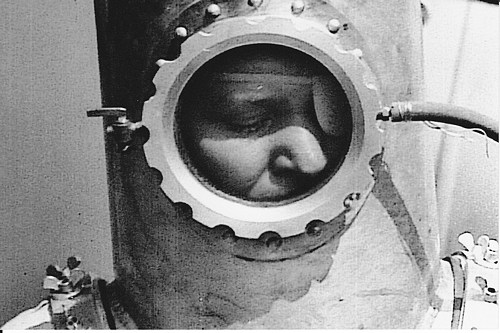
Wiley Post in his pressure suit
|
 American Aviation Historical Society