AAHS Logo  American Aviation Historical Society

1956 - 2025, Celebrating over 65+ Years of Service

MEMBERS SHOULD LOG IN FIRST TO ACCESS FULL ARTICLES

Back CoverInside FrontInside Back

Excerpts from
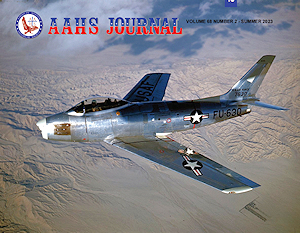
AAHS Journal, Vol. 68, No. 2 - Summer 2023
Table of Contents


Change of Address Notice

EFFECTIVE IMMEDIATELY

Please send all correspondence and USPS packages to this address.

American Aviation Historical Society
P.O. Box 483
Riverside, CA 92502-0483

FEDEX and UPS packages should be sent to:

American Aviation Historical Society
Flabob Airport
4130 Mennes Ave, Bldg. 56
Riverside, CA 92509


Evolution of the North American F-86


With its unique requirement for blending together such a wide range of the sciences, aviation has been one of the most stimulating, challenging, and prolific fields of technology in the history of mankind.

Its numerous products, evolving since the Wright Flyer, have set a pattern for the course of many human endeavors. At the same time, its uniqueness as a technology is highlighted by its touching so many of the esthetic senses.

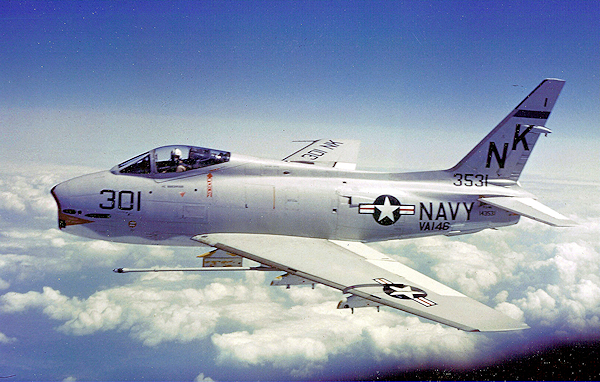
The evolution of the F-86 is a fitting example of this. It was beautiful, it was exciting and its outstanding Korean combat record against the MiG speaks for its quality (Figure 1).

We’ll explore the evolution of the F-86’s swept-back wing that was, of course, fundamental to the outstanding success of this fighter. It began 36 years ago with a straight wing, evolved into the F-86s we know, and is still ranks among the most esthetic airplane designs.

The Beginnings
The mid-1940s were paradoxical times marked by the unprecedented 1944 wartime peak annual production of nearly 100,000 aircraft, followed by the collapse or demobilization of the industry at the close of WWII (1945). It also marked by the excitement of the military’s conversion to jet propulsion and the beginnings of transonic and supersonic flight.

With the war still on, D-Day still months in the future, jet propulsion was beginning to have a profound effect on qualitative air superiority. The U.S. had placed several contracts aimed at rapidly introducing large quantities of jet fighters into the operational inventory. The P-80 was becoming operational, the P-84 was under contract and discussions were underway with other manufacturers about converting their production lines to jets.

As every experienced designer knows, even radical new designs tend to evolve through an iterative process of modification of already proven configurations and design features. Such was the case for North American’s new jet fighters. In view of the outstanding success of the P-51 Mustang, the Navy had contracted for a carrier-based version, the prototype of which successfully operated from the carrier USS Shangri La in November 1944. But, North American Aviation’s (NAA) Confidential Design Group, under Ed Schmued, was busy trying to work out the design of a jet powered version of the Mustang. One interesting variant combined both turboprop and turbojet power, but of a slightly later vintage. Several such designs were proposed to the Air Force, but prior to any selection, the Navy decided to forego production of the carrier-based Mustang and opted instead for development of a new jet fighter, the XFJ-1. As grossly different as the overall configurations were, the similarity of the XFJ-1 wing to the Mustang is equally apparent. To maintain full advantage of the high speed wing, a circular inlet and straight-through duct replaced the more conventional side or wing inlets. The cockpit sitting atop this circular duct added to the XFJ-l’s somewhat dumpy appearance.

Shortly after the XFJ-1 began, the Air Force selected a similar straight wing design that was designated the XP-86. The primary differences stemmed from elimination of the design constraints for carrier suitability and slimming down the bulky fuselage by shifting some fuselage fuel to wing tanks. Also, by this time, duct design criteria had been developed that allowed maintaining high recoveries with an elliptical inlet with enough longitudinal curvature to further slim down the fuselage.

While the design of the two NAA fighters progressed in Inglewood, Calif., the D-Day Invasion had taken place in Europe and our aircraft began to encounter Germany’s new Me-262, which had become operational as an interceptor in September 1944. By early 1945, captured German wind-tunnel data on wing sweepback had been obtained by Technical Intelligence Survey teams and brought back to NAA. NACA’s Bob Jones had developed his wing sweep theory but at this time, little had been done in the U.S. to verify the concept or to understand it more fully. Larry Green, NAA’s head of Design Aerodynamics, was competent at technical German, so he began to spend a great deal of time studying these reports and related interrogations of captured German scientists and engineers. A captured Me-262 was made available to NAA for detailed study at Los Angeles. Although the Me-262 had slight sweepback (15 degrees), there were rumors of an experimental prototype with fully sweptback wings. This was of particular interest to Green since he had earlier conducted . . .


North American FJ-4B


The St. Louis Aircraft Corporation

The St. Louis Car Company, established in 1887, had built a strong presence in the transportation business with railcars and streetcars. By the turn of the century, the company began exploring opportunities of expanding and the birth of aviation in the early 1900s seemed like a likely area to explore. St. Louis Car had already been exploring possible expansion of its business into aviation prior to WWI. In 1915, they had entered into an agreement with St. Louis aviator and designer, Thomas W. Benoist, to produce a large twin-engine flying boat of his design. Furthermore, records indicate that the company had constructed a single-engine and a twin-engine Benoist design as part of the relationship. St. Louis Car was prepared to produce as many as a thousand of the craft in one year. The partnership was contingent on a contract being secured from the British Government. The contract never materialized and only a single test article was produced and flown.[1,2]

World War I
Born of necessity during the First World War, the St. Louis Aircraft Corporation (SLAC) was a joint effort between the St. Louis Car Company and the Huttig Sash and Door Company. In 1917, the U.S. found itself in a situation where it needed to rapidly increase war production, particularly relative to aircraft production where the existing manufacturers’ capabilities of ramping up production was woefully inadequate to meet the needs.

In July 1917, the U.S. Government established the War Industries Board (WIB) to coordinate the purchase of war supplies for the War Department (U.S. Army) and the Navy Department. The WIB encouraged companies to use mass-production methods to increase efficiency and eliminate waste through standardization of products. Across the U.S. companies were encouraged to switch production to war materials. St. Louis Car and Huttig Door and Sash participated in these discussions and were excellent selections for aircraft manufacturing. Huttig Door and Sash had workers skilled in working with fir, spruce and pine – invaluable to aircraft manufacturing. St. Louis Car had workers skilled in fabricating metal fittings required for strengthening and assembling wooden structures. Both companies also had existing facilities that were easily converted to aircraft production.

Combining these assets led to the formation of the St. Louis Aircraft Corporation (SLAC). It was managed jointly with A.J. Siegel, president of Huttig Sash and Door serving, as president, and Edwin B. Meissner, vice-president of St. Louis Car, serving as vice-president of the company. St. Louis Aircraft was, therefore, uniquely prepared to produce aircraft using their existing facilities, employees and management.

The company received its first order in early 1918 for 450 Curtiss JN-4D military trainers. The first examples were ready for shipment in May. By the fall, production had reached a rate of 30 aircraft per week with 57 aircraft delivered in October 1918. Employment topped 900 at the same time. This first order was completed before the armistice and a second order had been received. The second order for 200 planes was canceled in late November 1918. St. Louis Aircraft received about $2,500,000 for their efforts.[3]

The wings and major wooden components were produced at Huttig facilities, while fuselage assembly and all metal work was performed at St. Louis Car facilities. Component parts were then tested and crated for shipment. No aircraft were actually test flown in St. Louis, nor apparently produced to flyable form. Several examples were apparently erected for publicity pictures and possibly for testing fittings, but all aircraft appear to have left the factory in crates on railcars.

The company didn’t have smooth sailing during this period. On April 27, 1918, it was hit with a labor strike over working conditions, wages and hours. The workers were out on strike for a period of three weeks before the basis of an agreement . . .


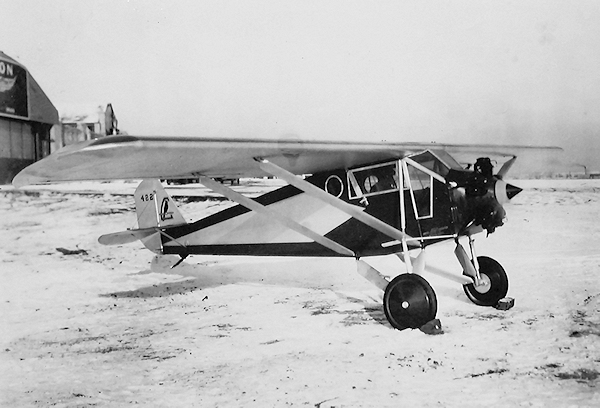
St. Louis Aircraft Corp. C2-60 Cardinal


Pioneering American Women Glider Pilots

In 1927, a wave of enthusiasm for aviation spread around the world. Smitten with Lindberghitis, citizens began a quest "to take to the skies." Youngsters built and flew balsa wood gliders. Men resurrected WWI aircraft or constructed aircraft in their backyards. Women discovered that flying was one sport that provided a sense of freedom and confidence from societal constraints. As Joseph Corn stated in his book, The Winged Gospel, "As pilots, women experienced feelings of strength, mastery and confidence which, particularly at a time when Victorian norms still rendered all strenuous effort and most activity by women suspect, seemed delicious indeed."

A small handful of extraordinary women overcame male prejudice and paved the way for a generation of competent and accomplished pilots. They effectively navigated both motorized aircraft and gliders. This article focuses on the pioneering American women glider pilots.

Maxine Dunlap
1908-1942
A resident of Pleasanton, Calif., Maxine Dunlap earned private pilot license #5894 in April 1928. She quickly accumulated 60 hours in the air before setting her sights on motorless flight. Following three weeks of lessons, Maxine entered the first glider contest held by the California Gliders Association on April 29, 1929. The event took place over the Ocean Beach sand dunes near San Francisco. Intending to qualify for a glider rating, she flew a Ferguson glider similar to a German training craft. She traveled 990 feet while staying aloft for 50 seconds. This exceeded the minimum of 30 seconds to receive a Class 3 glider license and eclipsed Amelia Earhart’s glider flight of 17 seconds. The U.S. Department of Commerce awarded her glider certificate number 8. She became the first American woman to obtain a glider pilot license of any kind. Even though she was airborne for less than a minute, Maxine successfully executed two S curves and most important, a smooth landing.
In March 1930, Maxine became president of the Bay Region California Gliding Club and supported competitions in the area. She also continued flying motor-powered aircraft. Her performances in the many air races across the country were notable. In 1935, she set a new 100-km world’s record for women for light airplanes in Tulsa, Oklahoma. Her top speed was 76.799 mph in Spartan’s first monoplane, a C2-60.
Maxine’s second husband, Coca-Cola executive and All-American tackle, Joseph J. Bennett Jr., provided the financial support necessary for his wife to continue flying. She purchased a 260-hp Stinson Gull Wing and became the family’s capable pilot. A Ninety-Nine’s newsletter related an amusing incident in her flying career when she made a forced landing in a rose garden. No damage was done, but a crowd quickly gathered. From the multitude of on-lookers a masculine voice drawled, "Now isn’t that just like a woman – landing on a bed of roses."[1]

Anne Lindbergh
1906-2001

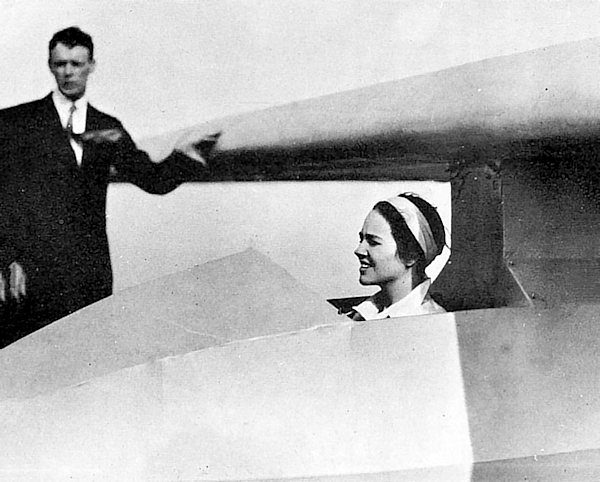
In 1930, both Charles and Anne Lindbergh switched from powered flight to motorless flight. They traveled to San Diego, the Air Capitol of the West, to take lessons from Hawley Bowlus, a former construction superintendent for the Spirit of St. Louis. He now operated the successful Bowlus Glider School and possessed a stellar reputation as a glider designer and instructor. Nine of the first ten licensed glider pilots in the United States were graduates of his school.

Charles successfully earned his first class glider license as Anne intently observed the process. Then, it was her turn. On January 29, 1930, she completed the primary course with 10 short flights in Tillie the Toiler (598M) and was ready for her solo flight. It was made from Mt. Soledad, an 800 foot . . .


Anne Morrow Lindbergh ready to launch


Kartveli & Theiblot; The Early Years of a Remarkable Association

In the mid-1920s, two young aeronautical engineers - destined to achieve greatness in the years ahead - were hard at work on the development of racing aircraft and cabin transports for the Société Industrielle des Métaux et du Bois, a Paris-based aviation firm. The two men were Alexander Kartveli and ArmancThieblot, both of whom later became chief engineers of Fairchild companies.

Kartveli, son of a magistrate in the Georgian city of Tiflis, had served as an artillery officer in the army of His Imperial Highness Nicholas II and had been sent to France in 1919 to continue his military education. With the takeover of his native Georgia by the forces of the revolution, Kartveli decided to remain in Paris. There he enrolled in both L’Ecole Superieure Aeronautique and L’Ecole Superieure d’Electricite. Armand Thieblot, born in Paris, had studied mathematics at the Sorbonne (University of Paris) and worked for almost a year at Société Generale Optique, a firm specializing in the design and manufacture of optical instruments. After a year of compulsory military training in the air service of the French army, Thieblot elected to pursue an aeronautical engineering career at Société Industrielle and there Kartveli later joined him.

Together with Edmond Chagniard, another young engineer who subsequently left the aviation field, Kartveli and Thieblot participated in the design of the single-seat Bernard SIMB V.2 (sometimes referred to as the Bernard-Ferbois V.2 being built by Société Industrielle des Métaux et du Bois ("SIMB") solely to capture the world’s maximum speed record. (In 1924 the existing record was 266.58 mph established under the rules and regulations of the Federation Aeronautique Internationale by Lt. A.J. Williams, USN, at Mitchel Field in a Curtiss R-2C1 racer.)

The Bernard SIMB V.2, powered by a 450-hp Hispano-Suiza engine, was completed first. Adjt. Chef. (Warrant Officer) A. Bonnett flew the Bernard at Istres, France, on November 11, 1924, at a speed of 243. 68mph, which broke the existing French record but fell far short of the recognized world mark. Taken back to the factory, a number of design modifications were made including shortening the wing span and aerodynamic clean up. One month later, on December 11, 1924, again at Istres, France, Bonnett’s Bernard was clocked at 278 mph, a speed which, indeed, bettered the official maximum speed for land monoplanes. However, this record did not stand. Bonnett made a second attempt on the same day, and was able to achieve a maximum speed of 278.48 mph, setting a world record that remained unbroken for eight years. (On September 3, 1932, Maj. Jimmy Doolittle recaptured the record for the United States, piloting his Granville Gee Bee Super-Sportster with an 800-hp P&W Wasp at an officially verified speed of 294.38 mph at Cleveland, Ohio.)

After the outstanding success of the monoplane racers, Kartveli, Thieblot and Chagniard were involved in the design of a Bernard cabin monoplane. But much of their thinking - and dreaming - revolved about the feasibility of transatlantic air travel. This was not mere visionary speculation; the trio soon set about specifically defining the aircraft they had in . . .


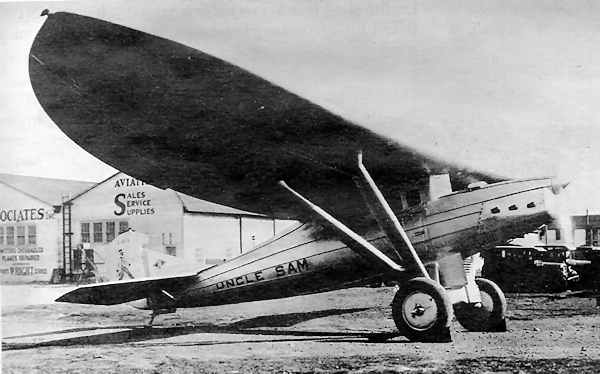
Columbia Air Lines Uncle Sam


The Hughes H-4 Hercules, After the Flight

• Damage to the H-4 flight controls from an "unknown cause" appeared in national and local newspapers, Aviation Week and Flight magazines in 1949.
• Reported by Howard Hughes to the FBI, the damage details were never followed up by the press. The story just disappeared.
• Did someone try to cause a catastrophic accident to the Hughes Hercules in a sabotage incident?
• Or was there a darker motive – to kill Howard Hughes?


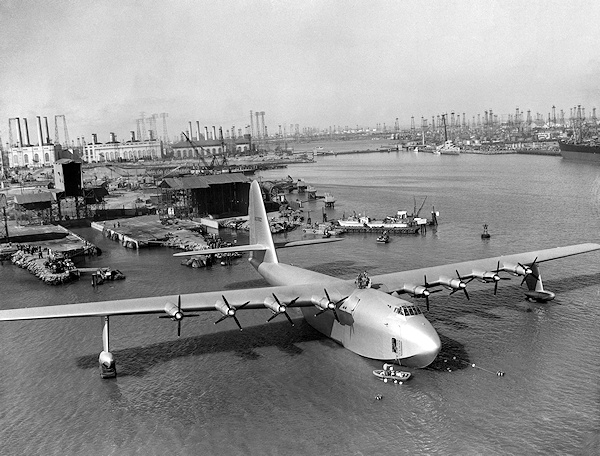
Growing up in Long Beach, Calif., in 1959 I "discovered" the Hughes H-4 Hercules and hangar location on Pier E, Terminal Island in Long Beach Harbor. Reading and collecting newspaper and magazine articles about the massive seaplane over the years, it was always a mystery why this aircraft was hidden away from public view in its unique, climate-controlled hangar. Several very good books were published about Hughes and the H-4 Hercules in the 1980s and in 2015.1 Each author speculated as to why the aircraft wasn’t test flown after the one day of taxi tests and short flight. Numerous theories on why flight tests didn’t occur over the years were put forth by Hughes engineers and others. We may never know the reasons, with certainty, why the flight testing was not completed.

In delving into the Hughes Aircraft Co. H-4 Hercules files, information came to light that has been overlooked and not covered by other authors. This information may have played a role in influencing Hughes to not continue flight tests.

During 1949, significant H-4 information made national and local newspapers and periodicals for a very brief period of time and then quickly dropped from the public’s eye. Curiously, little effort has been made by historians to follow up on these reports.

With Howard Hughes’ death in 1976, his creation (the H-4) was fortunately saved by the Aero Club of Southern California and displayed in special building, the Hughes Dome, built by the Wrather Corporation. With the passing of Jack Wrather, the Long Beach attraction was acquired by Disney, and the H-4 Hercules transferred ownership from the Aero Club to Evergreen Air and Space Museum, McMinnville, Ore., where it resides today.

My interest had always been the modifications and changes done to the flying boat after its initial test making it a true research vehicle for aircraft systems. Hughes had stated as much after the U.S. Government contract for three flying boats had been rewritten (in 1944) for one test and evaluation aircraft. A synopsis of the historic November 1947 H-4 Hercules launch event resulted in the short flight that set the stage for my own investigation.

By the summer of 1947, the H-4 Hercules was essentially complete in construction except for finishing the pneumatic/ hydraulic flight controls and integration of aircraft systems. Hughes was preparing to face a Congressional hearing on the Hughes Aircraft Co. wartime contracts performance. The hearing got underway in August and was contentious from the get-go. The public listened to Hughes defend his operation and shed light on one Senator Owen Brewster, who had a more than a casual relationship with Pan American Airways and its President, Juan Trippe. Free flights, gifts and influence peddling by Brewster were brought to light. Senator Ferguson, who chaired the hearings, was also challenged by Hughes, who was cheered by those observers in Washington attending the hearings. Hughes was never cited for malfeasance, only poor management practices. Senator Brewster came off as a weasel in Washington (eventually not being re-elected in 1952).

It was obvious that Hughes had some enemies in high places. The Hercules was grossly behind schedule, but as . . .


Hughes H-4 Hercules


Jules Verne Inspired the V-2 and U.S. Moon Rocket


The story of the V-2 rocket stretches behind and beyond its sneak attacks on London, encompassing development by space-flight dreamers, production by concentration-camp inmates, attacks from shifting hard-to-find sites, further development in Russia and the U.S., and motivating rockets to outer space. Building it, started before German leader Adolph Hitler’s arrival; then it was ignored, later cancelled, and finally embraced by him; leading to Russia, the U.S. and China reaching space and the moon.

The inventors of the V-2 rocket, probably the 20th century’s biggest aviation surprise, were inspired by early science fiction. France’s Jules Verne (1828-1905), wrote an imaginative story and its sequel in 1865 and 1870: "From the Earth to the Moon" and "Around the Moon," that created space flight enthusiasts worldwide. He was not the first, much earlier the Greek Lucian of Samosata (120-180 A.D.) originally brought the subject up. Englishman H.G. Wells’ "War of the Worlds" in 1897, was almost as exciting. Then, in Russia, Europe and the U.S., activity intensified on imagining, designing and building a rocket to get people to the Moon or Mars. At that time, manned rocket capabilities did not extend beyond the imagination of Jules Verne. This was in spite of his first mode of travel to space being in a cannon shell, using rockets only for directional control. Verne’s books continued to be published long after his death, and he is the second most translated author in the world. He wrote five space-flight novels and more than 50 exotic travel novels. At least a dozen movies were made from Verne books.

Seventy years after Verne, the development of the V-2 rocket Vengeance weapon in Peenemunde, Germany, was done by people who mostly wanted nothing more than to follow Jules Verne to the Moon. This was amply reflected by their actions over many years. V-2 development, production and operation had different leaders, organizations and locations. This story focuses on how each came about. The V-2 was a tremendous technical achievement, with such advanced capability that few could imagine or anticipate its existence. But it was a poor use of resources. Its story traces from Russia to France to the U.S. to Germany, and eventually to the Moon with the U.S. and Russia (Russia getting there first).1 The differences in technology and motivation resident in these countries made for an uneven pathway.

In Europe, Verne’s followers were playing with powder rockets and dreaming of going to space. They were NOT dreaming of rockets as weapons, although such had been their use in Asia and Europe since the early 1200s. Early on, there were four noted space and rocket pioneers: the Russian teacher Konstantin Tsiolkovsky, American physicist Robert Goddard, French space-scientist Robert Esnault-Pelterie, and German-Rumanian writer and rocket enthusiast Herman Oberth.

In Russia, schoolmaster Konstantin Tsiolkovsky in 1878-79 had read Verne, analyzed various aspects of space flight, the control of rockets and their engines, use of dirigibles and other possible ways to get into orbit and travel in space. He also published interplanetary travel stories that inspired his fellow Russians, who built the rockets that he only imagined. Those first Russian liquid-fuel designs were imagined in 1898, and flown in summer 1932 at low thrusts, but halted during Stalin pogroms. Tsiolkovsky died in 1935.

In 1912 Esnault-Pelteri gave popular lectures in Paris on spaceflight with solid- and liquid-fueled rockets based on studies he began around 1907. That year, the SS Titanic used solid-rocket flares to signal its distress after hitting the iceberg and needing rescue. Esnault-Pelterie in the 1930s published his book "L’Astronautique" on space flight, and lived to 1957, knowing spaceflight was finally happening.

In 1909, Robert Goddard in Massachusetts was also inspired by Verne for space flight, and started with powder rockets in 1915 because they were much simpler to construct. Goddard soon found they had limited range because powder fuel was mostly binder that did not burn with much energy, while liquid fuels burned with significantly more effectiveness in producing thrust. In 1917-18 he worked for the Army, and proposed liquid rockets, which they did not respond to. Much later, Goddard made the world’s first liquid-fueled rocket flight on March 16, 1926. He eventually filed 214 liquid-rocket patents. Most interestingly, some of Goddard’s rocket flights were done at . . .


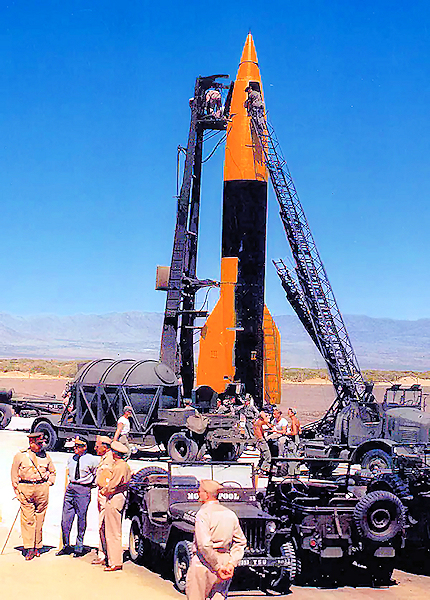
U.S. launch of a V-2 at White Sands


The National Naval Aviation Museum

No single facility can more thoroughly trace the historical development of U.S. naval aviation and the diverse, ever-advancing aircraft that were integral to it than the National Naval Aviation Museum in Pensacola, Florida, located at the very Naval Air Station Pensacola where it all began.

Naval Air Station Pensacola
Because of its dual advantages of the harbor and the abundant timber resources for shipbuilding, President John Quincy Adams and Secretary of the Navy Samuel Southard elected to construct a Navy yard on the southern tip of Escambia County in 1825 on a Pensacola Bay site, which, four years earlier, had been established as a naval squadron support location for operation in the Gulf of Mexico and the Caribbean.

Construction, commencing in 1826, soon demonstrated the value of the facility, whose wet basin, floating dry dock and building capability, gave birth to the stream frigate, the USS Pensacola, which was instrumental in two major Civil War battles – the Battle of Mobile Bay and the Battle of New Orleans.

However, the base’s strength was subsequently tested in 1862, when Confederate troops captured New Orleans and demolished it and again in 1906 when a hurricane and tidal wave destroyed what had proven to be a valiant and resilient effort to rebuild. The Pensacola yard was itself decommissioned five years later.

Nevertheless, the Navy’s aviation arm was literally waiting to take flight and became an integral part of its traditional water realm. After civilian pilot Eugene Ely landed on the makeshift wooden deck erected atop the cruiser USS Pennsylvania moored in San Francisco Bay in 1911 in his Curtiss Model D Pusher biplane, complete with arresting hook, the Navy Department witnessed the possibilities of this extension to ocean-plying ships. They urged Congress to include a provision for aeronautical development.

Toward this end, Captain W.I. Chambers contracted for three fledgling aircraft and pilots, including one from the Wright Brothers and two from Glenn H. Curtiss.

Aviation’s capabilities, through demonstration, were immediately apparent: an aircraft was successfully catapult-launched in 1912 and its aerially scouting capabilities, evidenced during experiments the following year, helped assure its position in the Navy.

Prior to the outbreak of WWI, an aviation training station, the first of its kind in the U.S., was established in 1914 on the site of the abandoned Navy yard in Pensacola. The initial facility, manned by nine officers and 23 mechanics, encompassed eight . . .


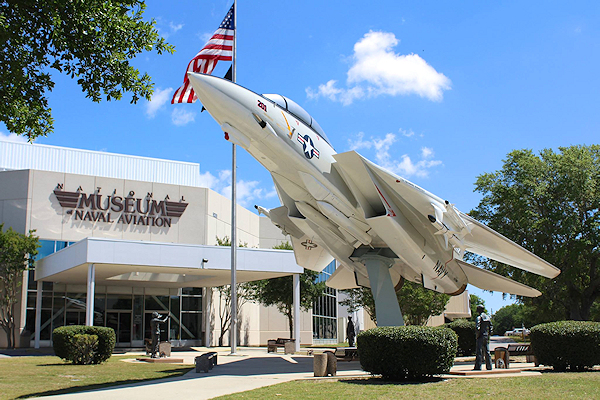
Grumman F-14 Tomcat guarding the entrance to the National Naval Aviation Musuem


Confession Corner

"Ssssh!"
462nd Fighter Squadron, 506th Fighter Group, 20th AF.


June 1945, Wingman Seale nosed his fighter downward for a rocket-firing pass at an enemy radio station on Chi-Chi Jima.

Suddenly his flight leader’s plane (2nd Lt. Albert C. Marklin, on his first mission) blew up in a flash from ground fire, and with little choice, Seale ripped through the flying debris of his companion’s ship. A warning light glowed on his instrument panel after a moment, he turned the Mustang off its run, nursing the roughly running and rapidly overheating engine, and began emergency procedures to limp homeward for Iwo Jima.

Seale’s call on the radio brought immediate response from his airborne buddies who were now escorting him to home base. An object from the exploding plane had damaged coolant lines in his P-51’s air scoop, and the liquid coolant slowly leaked away. Forty miles out of Iwo, the Mustang’s engine sighed its last revolution.

From 5,000 feet above the blue Pacific, Lt. Seale jettisoned his canopy, and began scrambling from the cockpit. Fellow airmen escorted the parachuting Birminghamian downward to the sea while they gave a blow-by-blow account of the bailout to Iwo by radio. After getting a definite fix on his position, the flight of Mustangs continued on to base, and Seale climbed aboard his rubber dinghy, erected a coverlet against the sun, then went to sleep while gentle sea swells rocked his raft like a cradle.

Sometime later, Seale was abruptly awakened by a sharp crack on his back. A Navy PC-1 had pulled alongside the raft and tossed a line to the downed pilot. Hauled aboard the rescue vessel, Lt. Seale was treated to his first fresh water shower in months, and was given the ship captain’s bunk where he promptly went back to sleep. Hours dragged by until the Air Corps pilot was awakened, and finally deposited safely back on Iwo Jima to rejoin his squadron.

Here, he brushed aside all but a short account of his experiences, and headed for his quarters where he was again sleeping very shortly. Various reporters that heard of the pilot’s episode, interviewed him the next day for articles for publication. One account appeared in the Brief, a weekly publication of Strategic Air Forces, prepared by the division of Information and Education. A vivid record was written of the bailout, his climbing aboard the raft and going to sleep, the pickup by the . . .


Lt. Seale sleeping in his raft after ditching his fighter.


Forum of Flight

This issue of the Forum focuses on a collection of photos submitted by Steve Johnston covering about a 12 year period and a variety of different types.

The FORUM is presented as an opportunity for each member to participate in the Journal by submitting interesting or unusual photographs. Most of the images come from contributions to the AAHS archives. Unfortunately, with older images the contributor information has been lost. Where known, we acknowledge them.

Negatives, slides, black-and-white or color photos with good contrast may be used if they have smooth surfaces. Digital submissions are also acceptable, but please provide high resolution images (>3,000 pixels wide). Please include as much information as possible about the image such as: date, place, msn (manufacturer’s serial number), names, etc., plus proper photo credit (it may be from your collection but taken by another photographer).

Send submissions to the Editorial Committee marked "Forum of Flight," P.O. Box 483, Riverside, CA 92502-0483. Mark any material to be returned: "Return to (your name and complete address)." Or you may wish to have your material added to the AAHS photo archives.


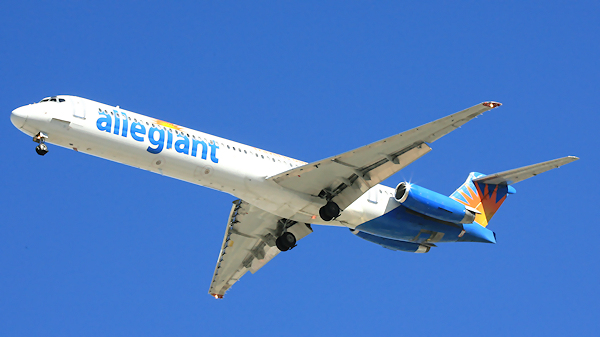
Allegiant Airlines McDonnell Douglas MD-88


CEO’s Message

As we close the Huntington Beach office, a cost saving measure, and consolidate the Society’s assets at Flabob, we have to take a serious look at our holdings. What material is useful? What is duplicated? And the tough question, what material will be of most value to our members? Addressing these issues will allow us to make better use of our resources and to find new homes for material we can’t use.

With space limitations, what should AAHS be preserving, as part of our mission, and what can we pare away? We also need to consider how technology has changed the way we access information. Historically, our members have accumulated personal files of magazine clippings on subjects of interest. Today, much of this is now stored digitally on our personal computers, or is easily found through searches on the Internet. Should the Society keep and store multiple file cabinets of magazine clippings that we have accumulated over the years?

With due diligence, we’ve been taking a hard look at exactly what IS in our file cabinets, and realize that we need to be smarter about what we hang on to. For example, the AAHS periodical collection includes all the published Air Trails magazines (with its various titles) from 1937-1955. Similarly, we also have file folders with many clippings from Air Trails publications, sorted by a particular airplane manufacturer or model. It’s a straightforward decision to keep the Air Trails magazine collection, and jettison the clippings. Using this approach, we can downsize a couple of bankers boxes of information.

But how to tackle the other 90% of paper materials we have? Taking advantage of current technology, we’ve been sampling the kinds of materials we have on hand versus what could be found digitally, via Google, library database subscription services, CD collections, etc.

We’ve found much of the information in our paper files is available digitally, and more is becoming available all the time. Internet data is only as reliable as the owner of the website, however. And, digital information has its own storage issues. While we won’t solve all our storage issues overnight, the AAHS will continue to retain older, original publications as we look to digitally store other material that is important to our collection. We are also committed to acquiring access to reputable online information services, to better assist members in researching aviation history topics.

Have some ideas or suggestions to support our mission of aviation history preservation? Let us know at prez@aahs-online.org!

Jerri Bergen
Chief Executive Officer