AAHS Logo  American Aviation Historical Society

1956 - 2025, Celebrating over 65+ Years of Service

MEMBERS SHOULD LOG IN FIRST TO ACCESS FULL ARTICLES

Back CoverInside FrontInside Back

Excerpts from
AAHS Journal, Vol. 69, No. 3 - Fall 2024

Table of Contents


Best wishes for a Happy Holiday


Best wishes for a Happy and Safe Holidays
and a Happy New Year

From your volunteer Staff at AAHS HQ.


Best Wishes


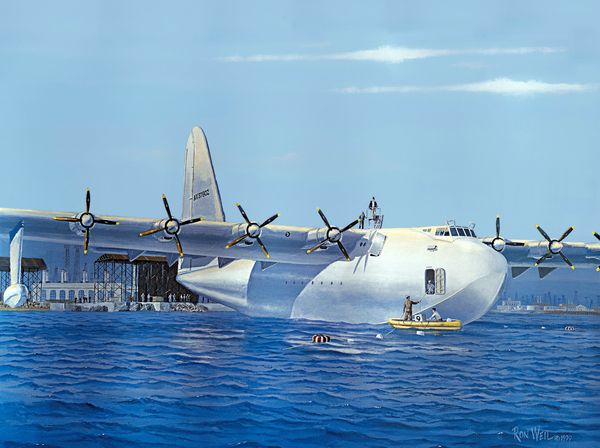
The Achilles Heel of the Hughes H-4 Hercules

When I was a young engineer in 1954, working at Transformer Engineers in Pasadena, Calif., I met a production engineer named Herb Pass. Herb was an extremely talented engineer. I often worked with him in the production methods of new or modified products. He seemed very brilliant in relation to the work he was doing. One day we were having a sandwich at lunch, and I asked him why he was working so far below his obvious talent. He told me he was an airframe design engineer and worked on the empennage of the Hughes H-4 Hercules. He said he had talked Hughes out of using a three-finned vertical stabilizer. After the H-4 short test flight, Hughes fired Pass and told him he would never work in the aircraft industry again. As a young man, I didn’t pay much attention to the magnitude of the Hughes Flying Boat incident. I dismissed the story as a sad tale of woe. After this brief chat at lunch, we never spoke of it again.

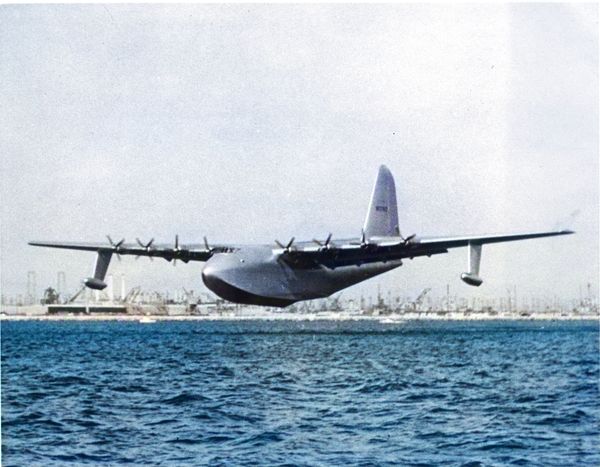
Over the years, I was aware of the myriad stories and interpretations of the H-4 flight. Most common was that the Hercules accidentally became airborne as the result of an unexpected wind gust. During a flight of 26 seconds, the aircraft covered about one mile at 70 feet of altitude, after which Hughes simply landed back on the surface of the water.

In the September 2023 Summer issue of AAHS Journal (Vol. 68, No.2), I read an article written by Howard Butcher, suggesting flutter in the H-4 empennage during the short flight may have been the reason the flight was terminated. The article also mentioned in a later inspection, damage was found at the root of the vertical stabilizer. Hughes reported it to the FBI as a potential act of sabotage and demanded a government investigation. The article brought back the memory of the statements made to me by Herb Pass. I called Howard, and told him of my conversation with Pass, and that Hughes had personally fired him shortly after the November 2, 1947, flight. This led to Howard and I doing extensive research of the empennage of the HK-1, or the H-4, as it became known after Henry Kaiser left the project.28 Much of the information comes from Howard’s large database relating to the Hughes Flying Boat. During our research, we found concern about the single vertical stabilizer among Hughes engineers all during the design process. In John McDonald’s book Howard Hughes and his Hercules, he mentions construction engineers’ discussions and extensive deliberations about the tail surfaces that had been engineered by Hughes.[1] Hughes repeatedly refused to consider . . .


Hughes H-4 Hercules


The First Night Air Mail: The Story of Jack H. Knight’s Epic Flight

The young men who flew the mail during the early days of the U.S. Air Mail Service were generally cut from the same mold - young, adventurous and veterans of WWI. But Jack Knight’s life, both before and after his airmail days, was unusual. He was born James Herbert Brockett on March 14, 1892, in Lincoln Center, Kansas. When he was about a year old his mother, a school teacher, died and his father brought her body back to her hometown of Buchanan, Mich., where James and his older sister were adopted by his aunt and uncle, Dr. Melvin Knight and his wife Emma.

As he grew up, James loved climbing things: trees, roofs, anything where he could feel closer to the sky. So naturally he was given the nickname "Sky." He was very small and fragile for his age, but his boyhood friends recalled that he was a determined competitor in sandlot baseball games. He enjoyed writing when it was about something that interested him, such as air travel.

He was also a practical joker. None of his pranks had serious consequences, but whenever there was mischief in his neighborhood, "Sky" Knight was one of the usual suspects.

In 1910 Knight enrolled at Michigan Agricultural College, now Michigan State University, studying mechanical engineering. There, he acquired another nickname, Jack. His practical jokes continued, eventually leading to his suspension. Knight then traveled to Chicago, where he joined Mead-Morrison Engineering Corporation as a draftsman and engineer.

As World War I raged, Knight became enamored with the idea of flying for Uncle Sam. He quit his job and joined the U.S. Army Air Service in 1917, reporting for flight training at Ellington Field, Texas. There, as a member of the 122nd Aero Squadron, Knight met some of his future fellow airmail pilots, including E. Hamilton Lee. Both Lee and Knight, much to their displeasure, were rated so highly that they were ordered to remain at Ellington as flight instructors after their training. Time and again Knight asked to be sent to a combat squadron, but the war ended with him still in the States.

Knight returned to his Chicago job for a time. Looking back on those days, he wrote: "One day the other members of my squadron, barnstorming on a Liberty Loan drive, came to Chicago. They were doing acrobatic flying and knew where I worked, so they staged a dogfight all around and over the building-with me on the roof watching. I got so excited I went downstairs and quit, wired Washington, D.C., and got on as a mail pilot." It was 1919, and the U.S. Air Mail Service was still just a novelty to most of the country, especially Congress, which was under pressure to give higher and higher yearly subsidies to the young organization. Officially begun on May15,1918, using military aircraft and fliers, the service was transferred on August 12, 1918, to the purview of the Post Office Department, . . .


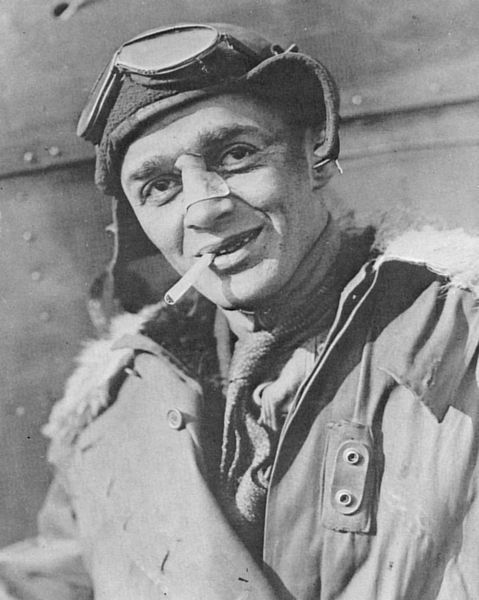
James H. McKnight shortly after his epic flight


The Evolution of "November Charlie" - United States Civil Aircraft Registration System between 1927 and 1946

Before 1926, although a gross generalization, civil aviation in the United States may be described as little short of completely unorganized chaos.

True, commercial interests - notably the insurance underwriters, which saw direct benefits in attaching the governmental cache to ownership of licensure of all sorts of conveyances - had lobbied intensively for some national standard for the emerging phenomenon called the aeroplane. In fact, they had been the prime movers on the short-lived, and far from complete, Underwriters’ Laboratories Aviation Record of 1922, which is story for another day.

Despite the inadequacies of the Underwriters initiative, they managed to assert sufficient lobbying pressure on the U.S. Congress to spur the normally ultra-conservative legislators of the day to finally do something to address the growing problem. The first attempt to organize a nationwide Federal response to civil aeronautics came in May 1926 when Congress finally passed the Air Commerce Act, which did not become effective until January 1927.

The Department of Commerce (DoC) was handed the task of organizing an Aeronautics Branch, which must have been an exciting but daunting challenge. Besides attending to the process of properly licensing all known aircraft in the country, it was also tasked with developing standards for construction and certification. In time these would become known as Approved Type Certificates (ATC’s). Included was the periodic inspection of each and every aircraft attendant to renewals of their licenses. But that was not all.

Even though the subtitle of the new law seemed simple, reading "An act to encourage and regulate the use of aircraft in commerce and for other purposes," the relatively small Branch was stunned to learn that the devil was indeed in the details. They were also charged with:

  • Encouraging the establishment of airports, civil airways and other air navigation facilities.
  • Making recommendations to the Secretary of Agriculture concerning weather service.
  • Studying the possibilities for the development of air commerce, the aeronautical industry itself, the [then]current state of the art, and to collect and disseminate information on these subjects.
  • Advising the Bureau of Standards and other agencies concerning research and development relating to air navigation facilities.
  • Investigating, recording, and making public the causes of accidents in civil air navigation.
  • Exchanging information with foreign governments pertaining to civil air navigation.

To execute these tasks, the first Assistant Secretary of Commerce appointed to oversee all of this was William Patterson MacCracken, Jr. He was just 37-years old. A WWI era U.S. Army Air Service veteran himself, he was an unusually well qualified Presidential appointment, and unquestionably the right man for the job.

His first measure, in sizing up the task before him, was to organize his Branch into three functional Divisions: Air Regulations, Airways, and Air Information. One of his original staffers was Clarence Marshall Young. MacCracken assigned him as head of the Air Regulations Division - yet another fortuitous posting, and a name that soon became one of the best known amongst U.S. civil aircraft owners and operators.

Before any of these measures could be addressed, the Aeronautics Branch was faced with a much more immediate and pressing task: locating the owners of all aircraft then extant in civilian hands in the country.

Word of the new rules and regulations was circulated as widely as possible nationwide and into the (then) Territories of Alaska and Hawaii. For the most part this was done using the solitary practical media available at the time - newspapers. Data was amassed from the aeronautical literature of the day that supported the efforts of the infant Branch.

The relatively small staff, comprised for the most part of clerks and a sprinkling of engineers, was overwhelmed by the deluge of inquiries, quasi-applications, and protests that descended upon them.

These inquiries were nearly all hand-written, and with rudimentary addresses. The supervisors assigned stacks of incoming mail to each clerk, who then attempted to make sense of each item of correspondence. Then, by return mail, send each correspondent copies of the application forms and copies of the new Federal rules for the regulation of aviation. These had been initially drafted in September 1926, but that, after . . .


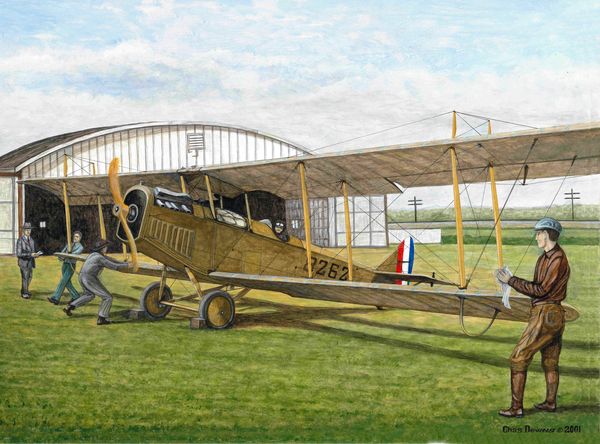
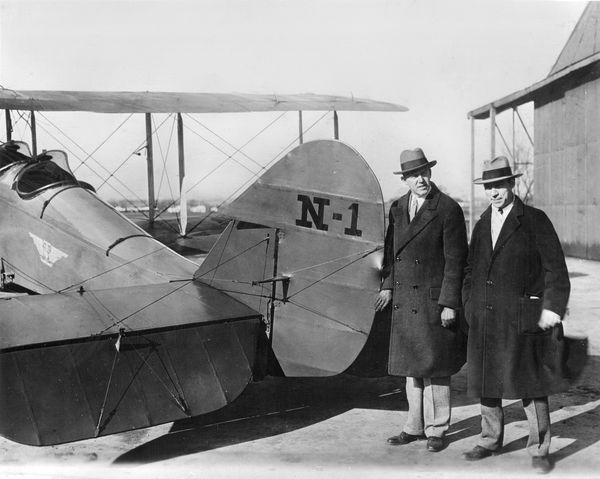
de Havilland D.H.4B, but clearly modified, N-1


Bernard Pietenpol and the Birth of Homebuilt Aviation

About 95 years ago a group of aviation enthusiasts concluded that the "big guys" had cornered the market on aircraft construction and sales, pricing most people out of owning airplanes. They set out to design planes that could be easily built and safely flown by novice pilots. Their success marked the beginning of the homebuilt movement. Much to the disapproval of traditional aircraft manufacturers, who lobbied for legislation to quash the nascent movement, homebuilt designs by pioneers such as Edward Heath, O.C. Corben and Bernard Pietenpol proved extremely popular.

Although Pietenpol actually constructed very few airplanes, many still consider him the father of homebuilt aviation. What’s more, the plans for two of his deigns, the single-seat Sky Scout and two-place Air Camper, are still being sold today.

Pietenpol was born in 1901 and raised in the southern Minnesota community of Cherry Grove. He showed remarkable mechanical aptitude as he grew up, building and rebuilding his share of automobiles and motorcycles. He also became intrigued by airplanes, but found flying too expensive. Pietenpol decided the cheapest way to obtain his own flying machine would be to design and build it himself.

With the help of his wood­worker father-in-law, W.J. Krueger, and two friends, Don Finke and Orrin Hoopman, Pietenpol began experimenting with various wing and fuselage designs, as well as the engines to power them. He was convinced that automotive engines, which were much cheaper and more readily available than aircraft powerplants, could be used to propel planes. Given their goal, to develop an airplane that anyone could afford to purchase, build and fly without the need for expensive factory-supplied parts or special construction expertise - the search for the best combination involved a series of trials and errors. Pietenpol not only wanted an airplane that was easy to construct, it also had to be reasonably easy to pilot, since many of those he envisioned flying it would be, like him, novices.

Their first attempt was a small biplane on which they bolted a Ford Model T engine - very cheap and plentiful at the time. . . .


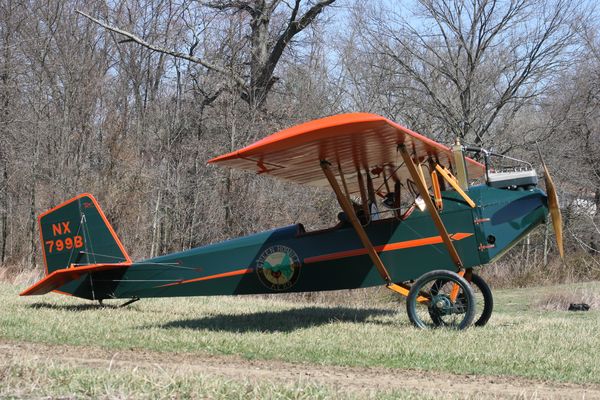
Pietenpol Air Camper


Trenton-Mercer Airport: New Jersey’s Secondary Airfield

The two paid parking lots, reflecting their aviation-related purposes with the names of "Tuskegee Airmen" and "Amelia Earhart," were relatively full, indicating passenger activity here. The single short, shabby, slanted-roof terminal was the only structure that served as the interface between the land- and airside portions of the field, although the few movements now visible were those of a Cessna 172 and a business jet. A handful of picnic tables on a grass area separated from the ramp by a chain link fence were indicative of a small, hometown airport.

Located in the shadows of Newark Liberty International, the majority of the airline departures it witnessed today were apparently those above, as a line of A320s and Next-Generation 737s adhered to their standard instrument departure clearances at considerable altitude from it, perhaps oblivious to its existence and ignorant of its purpose.

But the engraved rock next to the terminal brought both into focus. "Trenton-Mercer Airport County Executive Brian M. Hughes and the Board of Chosen Freeholders commemorate Mercer-County Airport, 90th Anniversary, October 26, 1929 - October 26, 2019," it said.

Although what could be considered New Jersey’s secondary commercial airfield seemed to take a very back seat to its primary Newark one, this almost century-old facility had served its unique, but more limited purpose and it had offered its own airline service during more than half that time.

A small part of it occurred now, as a Frontier Airlines A320 taxied into its parking position and was immediately prepared for its return flight to Orlando.

Airport Origins and History

Located in Ewing Township in Mercer County, New Jersey, the airport is within a 35-mile radius of 10 of New Jersey’s 21 counties and three of Pennsylvania’s counties, including the city of Philadelphia," according to the Airport Master Plan Update 2018 prepared in cooperation with Urban Engineers and McFarland Johnson. "It is located approximately four miles from the state capital, Trenton. "(It) is convenient for much of Pennsylvania’s greater Northeast Philadelphia region, particularly Bucks and Montgomery counties and is approximately 40 miles from Philadelphia International Airport."

It evolved from grass roots beginnings. Located on the west side of now-designated I-95, it was little more than Alfred Reeder’s farm adjacent to Bear Tavern Road in Ewing, occasionally fielding private . . .


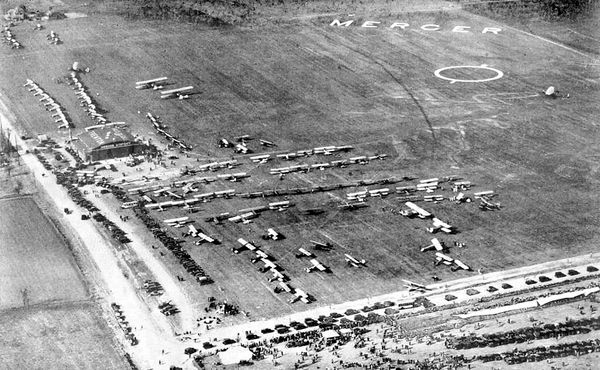
Mecer Airport ca. 1934


Forum of Flight

The National Archives and Records Administration (NARA) is responsible for collecting and preserving millions of records created by all branches of government. Within these records are thousands of digitized images made by the armed forces, the FAA and its predecessors, NASA, etc., that the aviation historian may find useful.

Many of the "choicer" examples, including a few presented in this edition of the Forum, have been published over the years, but if you’re searching for images to support a research project, don’t overlook NARA. Go to https://catalog.archives.gov/advanced-search and enter your search term. For best results, check "Photographs and other Graphic Materials" in the Type of Material section.

Negatives, slides, black-and-white, or color photos with good contrast may be used if they have smooth surfaces. Digital submissions are also acceptable, but please provide high resolution images (>3,000 pixels wide). Please include as much information as possible about the image such as: date, place, msn (manufacturer’s serial number), names, etc., plus proper photo credit (it may be from your collection but taken by another photographer).

Send submissions to the Editorial Committee marked "Forum of Flight," P.O. Box 483, Riverside, CA 92502-0483. Mark any material to be returned: "Return to (your name and complete address)." Or you may wish to have your material added to the AAHS photo archives.


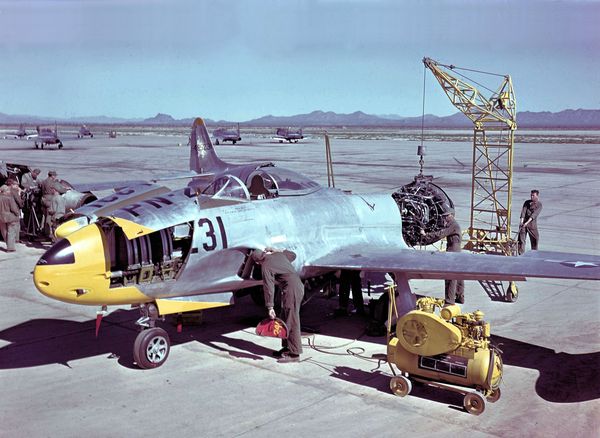
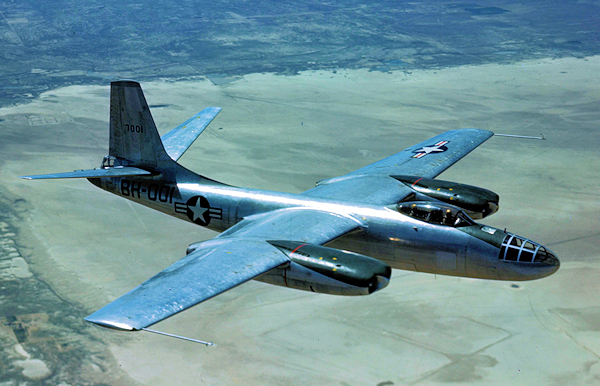
First production North American B-45, 47-001


News and Comments

Vol. 31, No. 3, Fall 1986 "More on the TWA Fokker F10A Crash," by Richard S. Allen

We have had a relative of Knute Rockne reach out to the AAHS for assistance relating to the TWA 599 Fokker crash in which he was killed.

Specifically, they are trying to find a copy of the official (CAA?) accident investigation report. Mr. Allen cites his copy of this document as being from the U.S. Air Force Museum Library. On querying them, they report that they do not have any record of it existing.

A similar request to NARA with respect to the CAA files they hold has resulted in a response that the accidents folder was "disposed."

After his death in 2008, many of Richard Allen’s files found a home at the Hudson Mohawk Industrial Gateway. A search of the Allen collection finding aid seems to indicate that his aviation files were either not included in this donation, or were subsequently disposed of.

There is a request in to the National Air and Space Museum archivists to see if they might have a copy of the accident report.

This is inclusive at this time.

Questions that might be able to help locate a copy:

Do you have in your files, or know where one might locate a copy of the official accident report of TWA Flight 599?

Do know where Richard S. Allen’s aviation files might have ended up?

Please response to this editor (editor@aahs-online.org) if you can assist in this search.

Hayden Hamilton
AAHS Managing Editor

Vol 69, No. 2. Summer 2024 – The 737 and the Thrust Reverser, or, Just One More Day by Bob Bogash

Dear Sir,

Enjoyed the Bogash story very much. Would enjoy a story about Bensen Gyrocopters with the follow on of Ken Brock. Or, a story on El Mirage Glider Port and the Breigleb family that ran it, I believe. In any event, I look forward to receiving my Journal.

Cordially,
Jack Gardner

New Book

Our friends in the Aviation Historical Society of Australia have alerted us to a new publication that may be of interest to Golden Age historians.

Koene Parmentier’s book, In Drie Dagen Naar Australië, was originally published in 1935 and has recently been translated from Dutch for the 90th Anniversary of the air race.

This first English edition by the captain of the Uiver, To Australia in Three Days, gives a rare insight into the Uiver’s participation in the London-Melbourne Air Race - a precursor to the international air travel we know today - and an almost minute-by-minute commentary on the drama that unfolded over Albury that stormy night in 1934. Paperback, 156 x 234mm, 320 pages, including 15 diagrams and maps, 109 photographs, and a new foreword by Dick Smith AC. This book is extraordinary because it is the pilot’s version of events, which was a real highlight to me, and this is the first time it has been translated to English, through the astute effort of the Uiver Memorial Community Trust. The book is now available for purchase directly from the UMCT at https://www.uivermemorial.org.au To Australia in Three Days comprises 320 pages, including 15 diagrams and maps, 109 photographs, and a new foreword by Australian entrepreneur and aviator . . .


Models for Sale

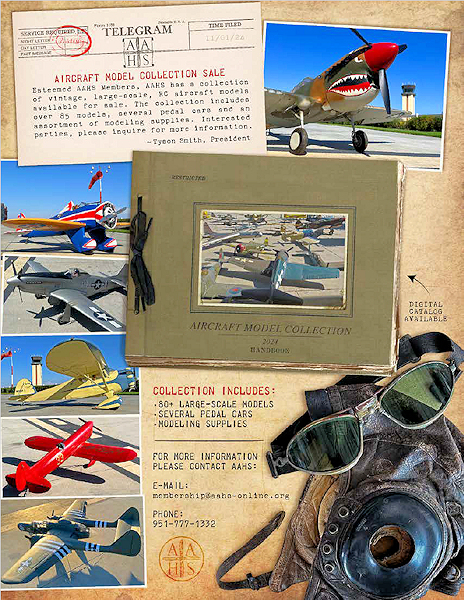
The AAHS has a collection of vintage, large-scale, aircraft models available for sale. The collection includes over 80 models, several pedal cars and an assortment of modeling supplies.

Interested parties, please inquire for more information.

A digital catalog is available.

Tyson Smith, President
Email: membership@aahs-online.org
Phone: 951-777-1332


Vintage A/C models for sale


CEO’s Message

On behalf of AAHS, I want to apologize for the extended delay in getting you the Summer AAHS Journal. Like many very small organizations, we have an extremely short ’bench,’ where losing one of our valuable contributors can have a visible, detrimental effect on meeting our objectives. And one of our most key players, Hayden Hamilton, AAHS Journal Editor, has been beset by many unanticipated challenges that have kept him from meeting publication deadlines. We’ve been adapting our workflow to transfer more publishing functions to other hands, but clearly we need to do more. To that end, for the first time, we’re outsourcing the technical layout tasks of the Journal publication and dispersing article preparation among several volunteers, instead of having them collected and reviewed by a single individual.

Hayden has performed the role of AAHS Journal Editor for over 19 years. His broad knowledge of aviation history, the AAHS image archives, technical knowledge of various publication software programs, and his passion to get a layout juuusssst right has all combined to provide AAHS readers with a superior quality reading experience, based largely upon his efforts (and of course, our AAHS contributors). We’ve grown to depend on Hayden to ’pull things together’ from a bewildering mash-up of articles, random photos, author suggestions, news headlines and donated materials, not once in a while, but every three months!

Better planning on our part would have had us working a succession plan to methodically train new individuals in key publishing tasks within our normal workflow, handing off responsibilities only when all knew their roles. But! (you knew that was coming, right?) we find that we’ll need to adapt our course midflight to meet both our schedules and your high quality expectations for upcoming Journals, without relying entirely on Hayden. Good news though, Hayden is still part of the publication team, and will ensure we don’t get too far off course while we chart our new path.

We’ll announce our new AAHS Journal Coordinator in a future Journal. In the meantime, we do appreciate your patience, and your understanding if our next few publications hits a bit of turbulence.

Jerri Bergen
AAHS CEO